What readers think of Big Numbers

Sometimes a picture (or three) is worth a thousand words…

First we have this…

Followed by this…

And finally, courtesy of a quick Google search covering the last two working days, this…

Sometimes it’s convenient to wrap up the big numbers for a headline (and the bigger the number, the better the headline, right?) but the fact is that it can be meaningless to a reader. Not saying I’m going to completely stop putting Big Numbers in headlines, but I’ll certainly think about whether I’m making it easier or harder for readers to decipher whether justice was done*. After all, a ten-strong gang jailed for a total of 100 years could well equate to10 years apiece, and each defendent might serve seven years of that sentence. Which is actually not that long.

* So well done Click Liverpool for a nice clear intro, which I didn’t spot it until after my screengrab.

Enhanced by Zemanta

Using search tools to inform news-gathering: Some data and examples

Back in October I wrote a guest blog post for Glyn Mottishead’s online and mobile journalism blog for his students, about how site searches could be a useful tool for journalists, I found the draft post again in my Google Docs the other day and thought, since some things had moved on since that was written, it merited a repost.
So, with apologies to Glyn for repeating myself, here’s an updated version:

 Seek, and sometimes ye shall find things that you weren’t actually looking for in the first place.
Take crowdsourcing, as an example; you start out with an idea, share it across online networks, and wait… and sometimes what comes back bears little resemblance to what you originally conceived. Sometimes it is a vast improvement.

We’ve been paying a lot more attention to Search in the Post and Echo newsroom recently and it’s paying off.
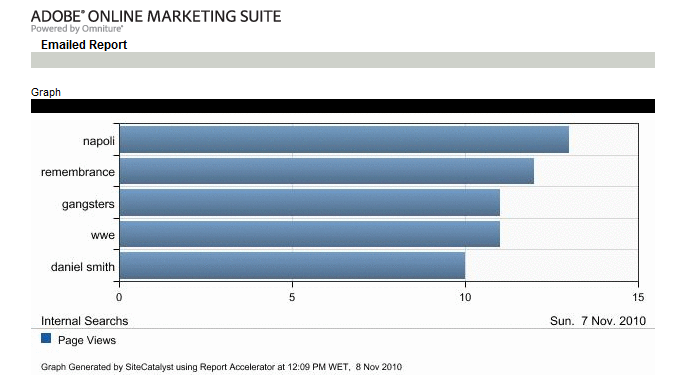
Twice a day, this drops into the inbox of heads of department in Editorial…


along with this…


It’s a self-updating dashboard created in Omniture Analytics, and it shows the sorts of internal site searches people are running. For example,  James McVey was a lad who died in tragic circumstances about three weeks ago, but his name still shows up in searches every day – in fact, last Thursday James was the most searched for subject on the site.  Daniel Smith is a gangster and these searched-for articles are no doubt being read (slowly, with brows furrowed by concentration) by Liverpool’s criminal underworld, while little Elliot Wild is the subject of a high-profile bone marrow campaign.


But what’s been happening in Landford Avenue? Or at Huyton Park pub? It would be well worth be checking out with local sources, just to see if the jungle drums have been beating about an incident; audiences will often come to our site to read the official take on something they already know the background on. And to comment, of course.
Note of caution: When we first introduced this initiative the press office at Merseyside Police were naturally confused by a sudden surge in reporters ringing up, apropos of nothing much, asking “Anything been going on at Accacia Avenue, Anywhere?”. We explained the background and also reined back on that sort of random approach – if you’re a press officer you tend to need a bit more to go on than a searched-for address.


So in-site search give us a (sometimes vague) nod as to where a news story might be brewing, and it can definitely show where readers’ interests lie – we continued to run James McVey stories because the audience has shown an appetite for that, and listening to your audience is key.


But these searches can also give us the kind of information that you would wear out a lot of shoe leather trying to get, often without success.
When someone is killed in violent circumstances on Merseyside – something that seems to happen with depressing regularity – there is a strong chance that the in-site search will, within hours, start showing multiple searches for a specific name. Twice we’ve run these names by official sources and got confirmation that it is indeed the deceased.
If the death involves a gun and someone who is – as the phrase goes – known to police (aka a gangster) then you can practically guarantee their name will crop up in a search before anything official has been released. The most recent example happened shortly before Christmas – two teenagers died in tragic circumstances during a car crash and their names showed up in the top 10 most searched-for terms within the hour, and remained there for several days.


From a digital team point of view, the daily site search round-ups have also visibly demonstrated – with proven results – the opportunities inherent in online journalism to those who are more print-focused in their jobs.
It can be easy for a newsroom to view the website as a separate entity, not as part of the platforms we use to reach audiences. Print is such a behemoth, with its deadlines, and its multiple pages that demand filling, that I understand how it eclipses digital in some journalists minds, even if I don’t like it. But these site searches reinforce the usefulness of the web, underline how readers are using it, how they don’t differentiate between paper and screen when it comes to finding out information – they just want it. And that has helped achieve a little culture shift in Editorial.


In-site search tells us so much, but it’s equally interesting to know where your non-audience is getting their information. We use Hitwise and it is a constant source of fascinating (and sometimes dispiriting) information about our un-users.

But knowing where you aren’t hitting audiences is vital; it helps us spot where our gaps are and, when appropriate, take steps editorially to address that. Take showbiz – the Echo score on Hitwise was low in March 2009 with most searches by Liverpool people for Hollyoaks (made by Liverpool company Lime, filmed in the city) going to Digital Spy. Which was crazy because we actually do a lot with Hollyoaks, and have a good relationship with them. So, showbiz coverage was upped, more galleries, better SEO, and we improved our rankings. Not an earth-shattering topic, but a small victory nonetheless. Equally, from a Advertising department point-of-view, knowing that a large proportion of people in our circulation area are searching for – to take a real example – jobs in the NHS in Liverpool – could help inform commercial campaigns.


So, search is something I’m particularly interested in at the moment – not just in-site but also Twitter Search* using the advance search features. Useful when looking for local tweets on specific topics/people (although if I do Liverpool searches it takes time to sort out the zillions of football-linked tweets from news ones). TwitterSearch also gave us a fairly powerful assist when a suspected gangster was shot in Liverpool just before Christmas. We had a possible name, but nothing confirmed, but a refined area Twitter search turned up people tweeting RIPs and calling the victim by his first name. Not concrete enough that you could print initially, but it gave us a good steer that we were on the right track, and also meant we could tweet people asking them for comments.

Most recently I’ve been using it to gauge how people feel about Scouse singer Rebecca Ferguson on XFactor, simply by ticking the positive/negative box on the advanced search. Turns out she’s pretty much universally loved, if you fancy a punt at Ladbrookes…

 With regards to Rebecca Ferguson, the results eventually showed she was indeed worth a punt if you were putting your money on the X Factor final two. Just goes to show what a powerful tool search can be.

Enhanced by Zemanta

The power of saying yes: The Register Citizen Open Newsroom project

I am fascinated by what’s going on at the Register Citizen Open Newsroom Project – I genuinely can’t stop thinking about it. I’ll read one of the team’s blog posts, look at some videos of opening day, and then go about my usual daily whatevers. Then, a while later, I find myself back reading another blog post by or about the project, looking at some more videos or photos, and still I am fascinated/impressed/jealous/desperate to steal their idea and do it too.

I know how hard it can be to get things done in mainstream media. The simplest of things – from replacing a lost cable on a piece of kit to adding a bit of code that lets users retweet stories – can take an age to achieve because media firms are big companies. And in big companies, fairly little tweaks tend to pass through several pairs of hands even though everyone agrees it’s the right thing to do. And sometimes they get caught in the cog wheels of corporate mechanisms. Or someone in charge of a part of the project leaves, and there’s no one to take up the slack… the reasons not to complete things stack up ad nauseum, ad infinitum.

But, just sometimes, someone says yes and things happen. I remember David Higgerson and I pitching the ‘let’s liveblog a day in the life of the Liverpool Daily Post‘ to the editor in early 2008, and he said yes. It felt so good to have someone say ‘yes’ without shining a light in every dark corner to spot the potential problems. We didn’t really know what we were getting into but we made it through ok and you know what? The paper still comes out, and the website is still there. The sky did not fall in for want of rubber-stamping.

But the Register Citizen Open Newsroom Project is another proposition altogether and I would love to know the steps by which it was achieved, and how long it took to get there. Because it takes the whole idea of open journalism and transparency to a new level by inviting people – anyone – to ‘come in and be part of the operation’.
Just stop and consider that for a minute; most newsrooms have policies on the numbers of people who can physically enter the editorial space – there’s the security issue, the health and safety issue, the inevitable fire risk assessment – that can make inviting people to see us in action difficult.
The Register Citizen has spilled itself out, however, and engulfed the community, rather than the other way around; this is clever. It’s made a public space – a newsroom cafe – and occupied that, alongside all the locals who chose to occupy it as well.


Register Citizen Newsroom Cafe from Journal Register Company on Vimeo.

Another thing I love about it is that John Paton doesn’t just say things, he does them.
He says:

Lousy journalism on multiple platforms is just lousy journalism in multiple ways.

 and

Stop focusing on the Print. It is in any newspaper’s DNA. It is not like you are going to forget to put out the newspaper. 

and (drum roll)

Put the Digital people in charge – of everything.

Really everything? Because, uh, I’m a digital person and I wouldn’t want to handle the payroll. But, joking aside, I get what he means. It’s like Opposite Day in the Register newsroom – instead of putting things in the paper then putting them online (unless it’s breaking news that everyone has, in which case it’s not considered precious) they do things the other way around. And online (and real world debate, courtesy of their public space) informs their print coverage. It’s so simple, and yet my brain struggles to grasp how someone managed to turn a ‘Why don’t we…’ into an actual, physical reality without crashing into a million different versions of “Yes, but…”.

Finally, there’s John Paton on the Benjamin Franklin Project:

We are changing our culture at JRC.With lousy I.T, and tools this project is happening. We have built sales support systems using an iPhone and free Google tools.
We have successfully printed pages on a press using only free web tools.
The next time some rep comes to your shop brandishing a $20M system – tell the price just went down. Way down.
Our Capital Expenditures have been reduced by half. Half.
But more importantly –
We have harnessed the power of our employees
And are starting to create a culture where they are empowered to experiment
We share all of the information and tools publicly.

Of all the things he says in that paragraph, the one that could make a difference is about Cap Ex being reduced by half. Because the money-go-round is where people start paying attention.

Enhanced by Zemanta

Giving readers data means stories don’t have endings – just evolutions

I found this from the New York Times interesting not just because of the high levels of engagement that it led to, but also because readers were actively comparing the respective results, as well as the data they had used to reach their conclusions.
The idea of data never really coming to an end – once a conclusion is reached, the conclusion is scrutinised and new data around that produced – is almost overwhelming in it’s implications for the lifecycle of news. Quite simply, data can evolve and move forward for as long as someone is prepared to scrutinise it I guess.

In my work, we have found when we run surveys online (particularly sports) readers want a very detailed breakdown of responses and numbers – they want all the detailed statistics that come out of a survey (ideally with visualisations of some form – even a basic bar chart) if it is to have value.  It reminds me of what my old Maths exam papers used to say – SHOW YOUR WORK.

As the Times highlighted*:

…”many readers asked for a tabulation of the responses, and taken together, they offer a glimpse of specific preferences within two groups: those who far prefer spending cuts, and those who want to mix cuts with tax increases. The responses also point to a deep divide between those two sides, illustrating why a solution is difficult”…

Some weeks ago a Liverpool Echo survey of LFC fans accidentally missed out on of the questions in the big results round-up. We had several stern comments from readers who wanted to know why a question was missing and what the results had been (not just the number of votes, but how many had voted, skipped the question etc). When we realised, and restored the missing information with an apology, we had more posts from readers marking their appreciation that they had been listened to and the data provided.

So, not enough to just tell – you have to show how you got there too. Not exactly an earth-shattering conclusion, I know, but both examples made an impression on me. A lesson to carry forward with me, I think.

* Big hat-tip to Doreen Marchionni who first flagged the NY Times article and reader demands for information on her Journalism as a Conversation blog. She observes: “Online news audiences not only love to hear it but perceive such interactivity as contributing to a story’s credibility”. I agree.

Enhanced by Zemanta

The virtual shop window

There is a story – and I’m told it’s not apocryphal – that the Liverpool Echo used to employ a man whose sole reason for existence was to tell advertisers to go away.
 Apparently, in the dim and distant past (I believe this means the 1960s but certainly there are old timers who remember the phenomenon) people wanting to place adverts in that night’s Echo would be queuing in the front reception area in the hope of winning a slot.
Sometime during the afternoon, this worthy would be dispatched to tell them there was simply no more room for adverts and they should all go home and try their luck again the following day. I’ve heard this story a few times – it’s always told with a rueful laugh and a ‘if only’ nod at the current situation – but it doesn’t get any more incredible with each telling.
I’d love to know if other papers had similar roles within their workforce. Anyway, I saw this photo today* …

… it shows the Brockton Enterprise newspaper,  circa1940, complete with a ‘news feed’ powered by windows (rather than Windows) and I thought it was just great. I love that a paper was putting its information out into the world like that, using the front of its office as an extension of the front page, and a way of spreading information further. Obviously the hope was that a lot of those passing eyeballs could be converted into sales but there would have been no guarantee.
Somewhere along the way, it feels like newspapers lost sight of getting the story out there, in people’s hands, in front of their eyes, and instead started following the line of it’s not a story until we’ve told it (sometimes phrased as it’s not old until it’s told – a homily absolutely loathe). And lately it seems the shift has moved again, to encompass whether that story should be told free – in print or online. Holding stories because you haven’t got the space/are planning ahead/ in print was our stock-in-trade for years; we don’t have the issue of too little space online but putting it all out there for the audience is a digital v print battle that gets fought on a daily basis. Sometimes you win, sometimes you lose, every time it happens you wonder why the argument still needs to be had.
Debate about charging online, paywalls, pay-per-click, audience growth, unique users, page views et al, but at the end of the day you become a journalist because you get to tell people things they didn’t know. Important, interesting, fun or unusual things (sometimes all of these). We have to start seeing the website as our shop window.  
* Photo found on the Brain Traffic blog via Doug Fisher’s Common Sense Journalism blog (always a worthwhile read).


Enhanced by Zemanta

Site searches – tttttttttttttttttttttttttttttoo baffling for words

Several times a day, an automated message drops into my inbox telling me the most searched for terms on the Liverpool Echo site.
It’s an idea we appropriated from the Manchester Evening News a while ago and, as well as just being an informative overview of what users are looking for, it’s proved popular with newsdesk types as it can give a heads-up on a story we don’t know about.

We use analytics all the time to look at what is popular on the site, but the automated search-terms round-up will often flag up a name that’s being repeatedly searched for; if we don’t recognise that name, it may well be connected to a news story – we’ve found out the names of fatal rta victims before they were released by the police through friends searching for the story by name on the site.

We’ve also had some random ones – The World being searched for in the latest one is a cruise liner that visited Liverpool at the weekend but how do you explain the phrase ‘knicker sniffer’ being the top searched for term on the site recently? There wasn’t a court case because we checked, but there were dozens of searches for it. Police could offer no enlightenment either… but I bet there will be a court case coming up in the near future involving that term (although probably in slightly more legalese).

But today’s is a little baffling:

That’s ‘tttttttttttttttttttttttttttttttttttttttttttttttttttttttttt’ and ‘tttttttttttttttttttttttttttsssssssssssssss’, just to be clear. No way it could be a repeated, random elbow on a keyboard surely? But we’ve puzzled and come up blank. Answers on a postcard please.

Enhanced by Zemanta

Some conflicting thoughts on Facebook

Facebook logo

Facebook has been on my mind this week.
 First of all it published some advice to the Meeja on how journalists can get the most out of using the social network which, while a little heavy on the exclaimation marks, seems useful and has some good pointers. It’s a best practice guide for reporters who want to know more about using Facebook in a professional capacity, to promote their work, seek feedback, guage public opinion, crowdsource ideas and more. Plus it allows them keep their personal/professional networking somewhat separate (we’ve all seen examples of what happens when Facebook Status Goes Bad).

Then, via Paul Bradshaw’s OJB, I came across a blog post on the BBC College of Journalism site that made me reconsider all of the above.


First up, the new Facebook media guide.

facebook2

I like this idea because it offers good, entry-level engagement opportunity. Editorial types who perhaps aren’t wholly signed up to the idea of using platforms other than print to share news probably do use Facebook, for communicating with friends, sharing information, playing games, lurking and generally displaying their interests and intents. This means it’s a familiar, easy environment to try out audience interaction and engagement. I think some journalists could find having their own professional Facebook page very useful, although early adopters in the newsroom will already be using it, and Twitter, Foursquare, forums and blogs, plus their own title’s website, to engage anyway.

Meanwhile, over on the Collegeof Journalism site, there’s some fascinating Facebook research. Drawing on the views and useage of 20 19-39-year-olds, who were asked how they consumed news via social media, it reveals that Facebook is their main network, used on mobile (on-the-go contact) and desktop/laptop (deeper interaction, engagement and consumption of news).

I found the survey fascinating and it’s well worth a read; the bullet points for me were:

  • Comment and discussion are a key component of enjoying news on Facebook…but most restricted that discussion to their own group of friends 
  • News interest is very much personal; people know what information they want to consume 
  • No real concensus on the type of news Facebook pages should host 
  • Media organisations pimping links are unlikely to find a large audience 
  • Facebook was not seen as a credible new site – users would visit a mainstream site to verify information 

 Looking at the Liverpool Echo’s Facebook site to see what was being sparking people’s interest, we currently have a platform that is more about consuming than conversing.

facebook

This is the ‘official’ Echo site, although by no means the only one.A few years ago, when regional papers went all Web 2.0, everyone started a Facebook page for their title. Then several other everyones at the same title went and did the same thing. And then a lot of them left, without telling a single colleague that those pages even existed, let alone passing on a login.
So you can have a number of Facebook pages/groups/fan pages that revolve around the same thing. If you search Liverpool Echo on Facebook you’ll find, among other things, a home delivery page, some non-associated Echo sites, and marketing pages for specific events or campaigns.

This particular Facebook page was established as the main Echo one in February 2009; it has nearly 1,400 friends. The online chat is always on, and I frequently get IM-ed by the Echo’s ‘friends’ who see the paper is online for chat and want to know the latest news – it happened twice as I was writing this post.
Some reporters use it for crowdsourcing, and some of the more outrageous gangster stories can lead to interesting comments but we could do so much more with it, given more time and more people. We get comments our links, which are bit.ly links mostly auto-posted via Twitter to the site, or video/photos, but people tend to use the Like button a lot more than they leave comments – a LOT of links get liked, or shared. So I can see why Facebook’s media guide would say the Like button can be a valuable tool for gauging reader opinion.

mayor

Monitoring Facebook is important. It’s also somewhat time-consuming  (among other things, I accepted 45 friend requests to the Echo when I logged on). Looking after your social media presence is just as important as making sure your newspaper ncompanion website is maintained properly; if a lie can run around the world before the truth has got its boots on, then a critical tweet can become a meme before a title has even noticed someone’s sent an angry @ reply, and a a conversation thread can develop on your Facebook page that is entirely independent (and way more colourfully worded) of anything you’d allow on your brand’s homepage.

Most of the national titles seem to have at least one dedicated editorial staff member who is the public face of community interaction. I don’t know anyone in the regional press with that specirfic remit but I may be wrong, although I’d imagine most titles rely on the digital editorial team to do a bit of everything – create multimedia content, manage the editorial look and content of the web pages, and interact across in-house and external digital platforms with audiences.
I’d also imagine that if you asked most senior media executives about online relationship strageties, they’d think you meant their CRM.
Which one of these two items – the BBC research or the How-to guide for Facebook – is more useful? For me, it’s the research. The guide is content; the research is context.

So, as I said, I have some conflicting thoughts on Facebook. On the one hand, I can see the merit of more interaction but what I actually believe in is better interaction; if we don’t manage what we have well enough now, where is the merit in doing more?
Of course, we should be improving and growing simultaneously.And yet, as the BBC research showed, Facebook users don’t necessarily want more or better – they just want what they want. The Like button can point us at that, but it can’t be all we rely on. But the research further shows – I think – that Facebook has a fundamental part to play in building a brand’s reach and social currency with an audience, but it only stretches so far – such as users still opting to check the veracity of a linked Facebook story on the title’s original homepage.
So should we really trust a Like button? And if our audience doesn’t particularly trust news on a Facebook site, why think too deeply about pushing content at them, when they will visit the source to verify it anyway? I’m sending myself round in circles with this. I’m sure the answer is out there, somewhere.

Enhanced by Zemanta

Journalist or blogger? Both, please.

The above is taken from Dictionary.net; I screengrabbed it as I particularly like the ‘interchange’ reference in no.2. I think it’s something that newsrooms can lose sight of from time to time.


How does a journalist come to accept and embrace the idea of ‘interchange’, when the industry is founded on ‘imparting’? I’d suggest the learning process is quite simple; it’s about the principles of open exchanges in a transparent platform. And I’d suggest that one of the best ways to understand this concept is to

BLOG 

Blogging remains one of the best learning tools I’ve been given access to; whether it’s from working through my own thoughts and ideas on this blog or reading other blogs (be they the work of friends, journalists, thinkers or achievers) it’s taught, and continues to teach me, so much. In fact, blogging can also facilitate no.3 in this list – passage or means of passage between places – if you define a place as a state of mind.

I also find blogging quite comforting – it helps me clarify my thoughts about this industry (and the pace it innovates at), and to read or post responses to the views of others going through similar experience to my owns. In fact, this post was prompted by the need to write something that’s been bugging me out of my system.
I call myself a journalist because I trained in journalism and work in the news industry; I call myself a blogger because I (attempt to) impart or interchange thoughts and opinions via a platform called a blog. I feel defined by both these things, and I believe they are in no way mutually exclusive. In fact, I think they are now, more than ever, mutually dependent. And I’m happy about that.

Enhanced by Zemanta

Twitter, journalists and journalism students’ dissertation questions

It must be dissertation time of year again; requests for help from journalism students are winging their way to my inbox like swallows. They’re pretty varied too, ranging from considered requests for assistance, with specific questions and an explanation of the focus of the student’s work, to broad-brush “what you think the future holds for newspapers?” queries.

Now, I don’t like to be unhelpful, especially as some of these bright young things may one day end up being my boss, but it’s very time-consuming writing considered, lengthy responses each time someone asks me stuff; so I thought I might get proactive and blog about it. Because most of the questions that come to be are currently related to how journalists and newsrooms can use Twitter, I’ve done a little round-up, with some links.
I’ve also been asked about future-proofing and skills; anyone looking at that should take a trip to Glyn Mottishead’s blog where there’s an excellent survey on the subject.

So, Twitter thoughts. It’s fairly easy to find writers who dismiss social media as a flash in the pan, a collection of ‘I’m eating a bacon sandwich’ microblogs. Some think sporadic ‘I need news stories’ tweeting is about as far as they need to go, and others see it as a waste of time. Ironically, this Express article was removed from its website a few hours after being mocked by the Twittersphere for its sheer hopelessness and ignorance.

On a more positive note, a US survey has also found that more journalists are using social media to follow news than ever before although I’m more interested in how (if?) they engage with other users on these networks. Practically every newspaper has a news Twitter now but these are generally updated automatically. On a practical level, Twitter lets journalists follow in events in real-time, using hashtags (everything from #Haiti and #uksnow to #xfactor) talk to people directly involved, gauge public opinion (look how fast politicians discovered #ilovethenhs) and follow links to more information, still images, livestream footage, video, blog posts and more… it’s an incredibly rich seam once you tap into it. Consider how Tweetminster has revolutionised the way a journalist can follow politics, debate, and politicians in a short space of time. And it can be an effective shortcut for tracking other social networks too, as more users select multi-site publishing options to cross-post their content, from livestreaming on mobile phones to mobile podcasts.

Journalists who want to get the best out of Twitter know they need to treat it as a patch, just as they would would if a news editor gave them a geographical area or niche specialism. They get to know the place, the people, the tools, the language and the etiquette, and spend time learning how Twitter works. Those that don’t tend to write articles about how Twitter is a hunting ground for paedophiles.  I know some media firms have Twitter codes of conduct for their journalists – personally, I follow a ‘tweet unto others’ approach and tend to think any professional person who needs a guide telling them how to behave in public dealings with others while representing their employer should take a hard look at their own character.
I’ve said it before, as have many others (see the links below for a selection) Twitter helps journalists who use it to:

  • Build an ever-growing network (you have to think about who to follow, what you can discover from them, who they follow and why)
  • Initiate conversations
  • Engage with audiences 
  • Learn to deal with instant response – and public criticism on occasion 
  • Reach experts 
  • Be transparent 
  • Show how you reached your conclusions 
  • Promote your work and yourself 
  • Share your data (and learn to let that data to be used by others and passed on, possibly without your initial contribution getting name-checked)
  • Take raw information, apply checks, re-tweet with added information and value 
  • Curate collective tweets into an aggregated developing story
  • Be a real person to your audience

News companies in general can benefit from using Twitter (although The Guardian does seem to be unable to write a story about it without attracting buckets of comment-scorn) but there are some rules to follow I’d say, with Follow being the operative word. If your newspaper Twitter account has 4000 followers and follows 2 people, even if whoever runs it responds to @ messages, the impression is that it’s not engaging, it’s broadcasting.
At the Post and Echo we’ve had Twitter accounts for news, Liverpool FC and Everton FC for two years, later additions include football blogs @LFCBanter and @EFCBanter and blogging reporters who use their own accounts to tweet post updates.
Newspapers that engage in Twitter streams and feeds can build brand loyalty, help market their products and extend their reach in communities if their audience also believes it is being listened to, and at times of breaking news, a fast-moving Twitterfall on a big screen in the newsroom can be mesmerising. Twitter lists are great for readers – the New York Times section gives me List Envy.

Anyway, I suppose what I’m saying is that Twitter isn’t essential for journalists –  I know some who don’t use it, don’t like it, and don’t see the point of it but regularly get the front page just the same – but dismissing it as just another social network is an error. It might be noisy and require some effort, but there’s no escaping the fact that it is currently one of the most powerful online real world sharing and conversational tools goings.
In these days of editorial cutbacks, when something as vital as spending time out of the office building contacts and talking to people inevitably has to take a back seat to the demands of filling tomorrow’s news pages within a few short hours to meet earlier deadlines, it can be enormously useful.
You can have access to thousands of people in your local/specialist area, get to know what they care about, where they shop, socialise, work and what gets them riled. And they can get to know you too. All that in 140 characters or less.

Possibly useful links: 

The use of Twitter by American newspapers 
When Twitter beats local news outlets
How journalists can master Twitter
Journalists and Twitter: All talk or are you listening?
There’s a plane in the Hudson River (Twitpic)

Reporters put Twitter, Facebook to ‘Big Brother’ test … and the rebuttal –Journalists’ Social Media Sideshow Will Prove Nothing

Tweeting from court: The Casey Brooks case
The online conversational onion
Graphic: What can you accomplish in one week of Web 2.0
The rise of Twitter as a serious platform for discourse

Using animation to tell a news story

No, I’m honestly not suggesting a return to those horrible stilted avatars reading the news headlines, but I do like the idea of using some animation to bring a reader into a story – particularly if the story is the latest in a long running saga and a handy recap of the tale-to-date would be useful.

I made my first cartoon using Xtranormal today; I know it’s a site usually used for making training and presentation tools, but I was interested in whether it might work for journalists.
It took me about an hour and I had a lot of fun doing it. As the clip embedded here explains, I chose an avatar (there’s everything from corporate to robot avatars available but I fancied having blue hair) and gave it a voice (she’s really plummy unfortunately) then started adding animations.

The script is translated to audio, and it does sound stilted, although when I played around with some of the words and punctuation it improved. I think if I’d spent more time on it I could have got it to flow better.
So I know it’s not Toy Story but it does the job, and I was more interested in seeing how efficiently it worked, and how long it took to put together, than the style and content.

Anyway, it made me think: why shouldn’t we incorporate more animation in our websites? I don’t mean some ‘toon cat informing us of a moider in a local suburb, I’m thinking more about the options to introduce some fun back into what we do, and what we provide for our audience.
I’d love to see reporters being given time to make multimedia content – soundslides, cartoon, blogging, timelines, wordclouds – to compliment the words they have to churn out every day.

So, this is my first cartoon, made for free on a free site which offers paying customers more characters, audio, sets and other options.