MoJocon15 organised by RTÉ

#mojocon15 part I: Talking mobile innovation and storytelling
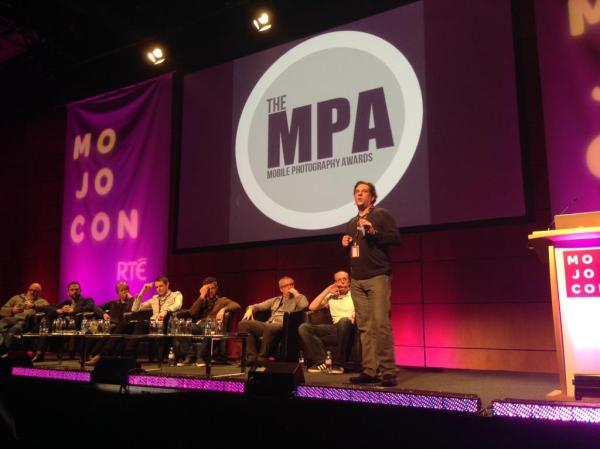
MoJocon15 organised by RTÉ
Daniel Berman speaking at Mojocon

March 27 and 28 were spent immersed in the world of mobile, journalism, storytelling and content creation, courtesy of the first Mobile Journalism Conference held in Dublin and organised by broadcaster RTÉ.

It was the most rewarding, packed and inspiring event – filled with incredible journalists and storytellers doing wonderful things, often armed with just a few pieces of tech, some apps and a determination to get the story out no matter what.

I was lucky enough to be asked to attend by my boss, and then even luckier to be asked to participate as a speaker by organiser Glen Mulcahy,  Innovation Lead with RTÉ, and author of this brilliant blog.

Day one got off to a flying start with two of the best keynotes talks I’ve heard, by Richard Sambrook and Gerd Leonhard.

Richard Sambrook said the changing immediacy of journalism was a challenge, and that “first and wrong was not first”; he also warned that mobile journalism wasn’t so much about phones as about the end of the age of satellite. “It’s the age of IP news” he told his audience. He cited mobile, social and realtime visual as the three disruptions to traditional news, and warned that to survive a newsroom had to understand and do all three. “Mobile is about much more than reorganising desks,” he said.

Gerd Leonhard said broadcasting was over and ‘broadbanding’ was the new world: “If you want a job [in journalism] what you do has to be above the api, because if it falls below the api a machine can do it”, was his takeaway message. He also introduced me to a word I’ve never heard before: ‘Humarithams’. As in, ‘stories can be made by algorithms, great stories are told by humarithms’.   Here’s an extra bit of Gerd bonus copy, for all those social media editors still traumatised by the recent Facebook upheavals: “Facebook is not in it for the journalism. It is not the reason Facebook exists… we should not be giving away our content to people who are not interested in news, but who are only interested in news as a commodity”.

The point I really took away from his talk was that the pace of change in most mainstream media is just too slow, given the speed of the innovations are happening away from our industry, in the world of tech and the world of the consumer – and we have to be faster, more nimble, and more open-eared/open-minded to trying new things.

Of course, as with any mobile conference I guess, you do come away wanting to do everything on a mobile phone and just bin off the desktop forever. But, in a world where the Nerd Herd was gathered in such great numbers, it was interesting that my presentation was the only one that day (as far as I can recall) to reference work that had been done in newsrooms with Google Glass. Occulus Rift didn’t get much of a mention either on day 1 (I can’t speak for all the day 2 workshops) and the most interesting wearable I saw was a Narrative camera that takes photos on a timer and which I now want so badly I’m ready to commit a crime for one.

The other talks that I found highlights from Day 1 were by Michael Rosenblum (aka the Father of Videography, according to his bio) who sucked all the air out of the room by informing journalists they were effectively “fucked” and that ‘editing, curating, publishing’ was the future for news organisations. I love a bit of agent provocateur, and I thought his talk was fascinating – designed to needle, provoke and make mainstream media ponder its role in such a world, and for indies to consider their responsibilities.

From the same panel, I really enjoyed Shadi Rahimi‘s talk on covering Ferguson with just mobile phones, what made AJ+ social media existence a faster, more fit-for-purpose news organisation than rivals. The answer, in a nutshell, is hitting the story out into the park on social as soon as you can verify it, and involving the audience as much as possible.

My panel was on challenging story concepts, boiled down to ‘what makes a good story?’ and as I’d begged to go first (my slides are at the bottom of this post, along with bonus content for reading that far – a video of @warrengatchell and I talking social media…) I was able to relax and actually listen to the rest of the speakers. Christian Payne was, as ever, compelling as he ran through the tech he uses for storytelling, dating back to 2003, and also somehow shoehorned a quick burst of harmonica playing into the session.

Here’s a link that’s worth a listen

Day 2 was a very special event – a group of us were taken around Dublin by two of the best mobile phone photographers in the business, and given a masterclass. But as this piece of writing is now reaching epic proportions, I’ll blog about that when I have a bit of time to do (hence ‘part I’ in this post’s title).

So I hope RTÉ get plenty of kudos for organising something so cool – they deserve all the plaudits going. Thank you for inviting me along to participate – it was an experience I am delighted to have been a part of. I met fascinating and cool people who do amazing things in mobile spaces, and I learned so much. I really don’t ask for much more from a conference.

I need to think less about Audience, more about People

Image

I managed to make it to the Digital Editors Network meet-up on Thursday – #visualDEN if you search for it on Twitter – and came away with head and notebook stuffed full of ideas.

The theme, as the hashtag suggests, was around the visualisation of stories, and talks touched covered the presentation of information through graphs, graphics and multimedia, among other things.

But the talk that metaphorically smacked me right between the eyes came from Amy Webb, because she made me realise I have to stop thinking about The Audience. 

I say it a lot – one of my hobby horses is the need to be ‘audience first’ – and we know a lot about The Audience because our analytics keep us informed.

I know what time they start waking up and reaching for their phones or tablets to scan the morning’s news agenda; I know when they get that pre-lunch attention dip and start surreptitiously  pointing the browser on their work desktop at interestingness on the internet; I know when they have their lunchbreak and head out armed with their mobile phone, and I know when they want to find out about their commute home. 

Most of all, I know The Audience likes to slob out at home, tablet or phone in hand, and watch TV while taking part in a running commentary with millions of others online. 

I know this because we monitor The Audience and try to meet its baby bird demands, as it gapes expectantly for content and entertainment. 

However, yesterday’s DEN made me realise, to paraphrase Ygritte: “You know nothing, Alison Gow”.

I have to stop thinking about The Audience and start thinking about The Person. There’s a tendency to adopt a hive-mind approach to your users when you use analytics to learn about them – we make assumptions because we can see the bigger picture, and this approach is fine and correct because the data backs our assumptions up, but the smaller picture offers a rewarding and rich canvas of information too. 

So I know that between, say 6am and 9am, The Audience is waking up and reaching for a device, but I really need to imagine what The Person is doing at that time. 

They might be using that tablet or phone in bed, or while blearily boiling the kettle, or using the bathroom. 

After 8am they might be on their commute – either in a car, so that’s the end of our involvement at that time, or on public transport, in which case they are still with us. 

What The Person probably wants at that time of the morning are snippets that fit around their busy routine; pieces of content that are quick and simple to consume and which deliver their information without requiring participation. Passive consumption of information: It’s probably why the Prozac lull of BBC Breakfast is so attractive compared to the technicolour of ITV.  

Does that mean a breaking news blog is ultimately, a frustrating use for The Person, as it involves a level of commitment to scrolling and finding things out? 

Putting myself in The Person’s shoes, I guess the answer has to be: Yes, sometimes; even with pinned summaries, it makes me work harder than I want, to find things out. 

However, breaking news live blogs are among the most popular things we do – so is the theory sound but the platform and delivery improvable? Or does it depend on the type of rolling news event being covered?

The answer may well be to ask users on one of our live blogs if it works for them but it’s never occurred to me to do so,because The Audience data tells me breaking news live blogs are a hit and, well, if it ain’t broke, don’t fix it. But what if, by tinkering, you could take something that wasn’t broken, and make it amazing? 

It’s the same with the lunchtime traffic spike – factor in what people have to do in their lunch hours (or 30 minutes), from heading out to find food/a cashpoint/a service suppliers etc etc to doing actual exercise, and you realise this is a very time-poor Audience indeed. 

Amy Webb, presenting at DEN, warned against consumer-centric design because it did not take account of people’s lives as individuals, and said, according to my shorthand, anyway: “Modern journalism is incompatible with devices so it is important to design for people, not their devices”.

So the thing I’m musing on post-DEN is this: When you are Audience-guided is there a danger you can become Person-blinded? 

 Pic: BBC