
It’s a thought-provoking piece of writing and well worth a read. (Also, incident is a great word, isn’t it? Covers everything from the reported death of the world’s most wanted man to a pub brawl).
Anyway, attribution of information when constructing a story is vital; journalists tend to be the questioners of eye-witnesses, rather than eye-witnesses themselves. Sometimes we’re several links down the chain, and sometimes the report of several statements gets prosed into appearing as a presentation of stone facts.
Tempering a slew of facts with acknowledgements that the information has come from a third party is helpful for readers, I suspect, but attribution with regards to content is an equally thorny issue.
YouTube, Flickr, Vimeo, Twitpic, Facebook, Twitter, Storify, ManyEyes visualisations… just a tiny fraction of created content that lives on the internet, in the wild, that journalists can use to source or display information. But when it comes to reusing this work – the attribution – it’s so important to show genesis, or at some point the accusations of making a smash-n-grab raid on social networks will come.
I’m probably a little obsessive about attribution, or showing source as a) I would hate to be accused of pillaging other people’s content and b) it’s easy to get permission or show original ownership. Things like a quick tweet exchange over the use of an image on Twitter, a link back to the video owner’s YouTube page, a link and a nod to the person who made the Storify you’ve embedded or the ManyEyes vis – so quick, so simple. So courteous.
Flickr is a different matter; I wouldn’t use a Flickr photo on this blog without checking the Creative Commons licensing and giving clear attribution. Professionally, I wouldn’t consider a Flickr photo unless the owner had given me express permission (either by joining a group with a consent form – like the Liverpool Daily Post’s Flickr group has – or through direct contact.
I had my own little attribution incident (see? such a handy word) recently when I made a photo-montage for WalesOnline and it got reproduced, without attribution.
But when I say I made, that’s incorrect attribution; to be accurate, I used Microsoft application software to create a photo-montage, and then something happened…
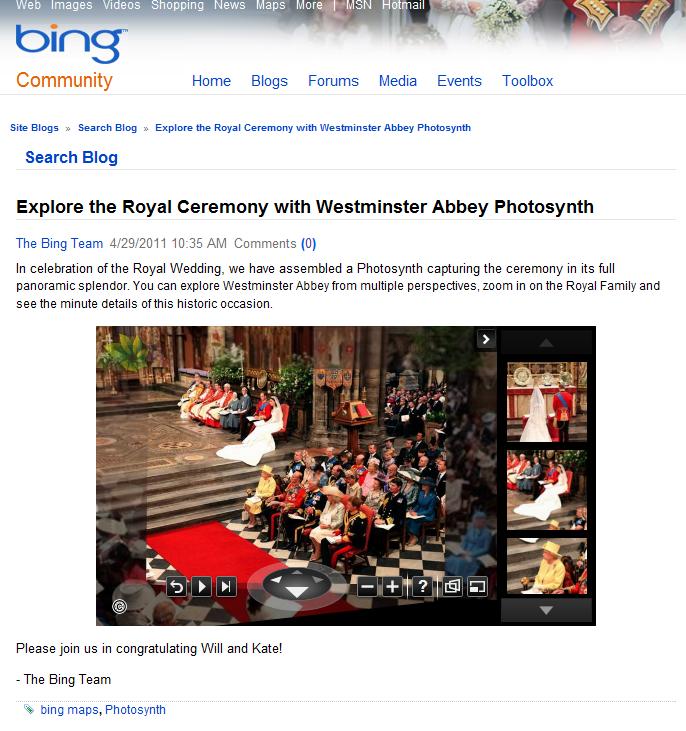
Have a look at this screengrab:
and this one from WalesOnline:
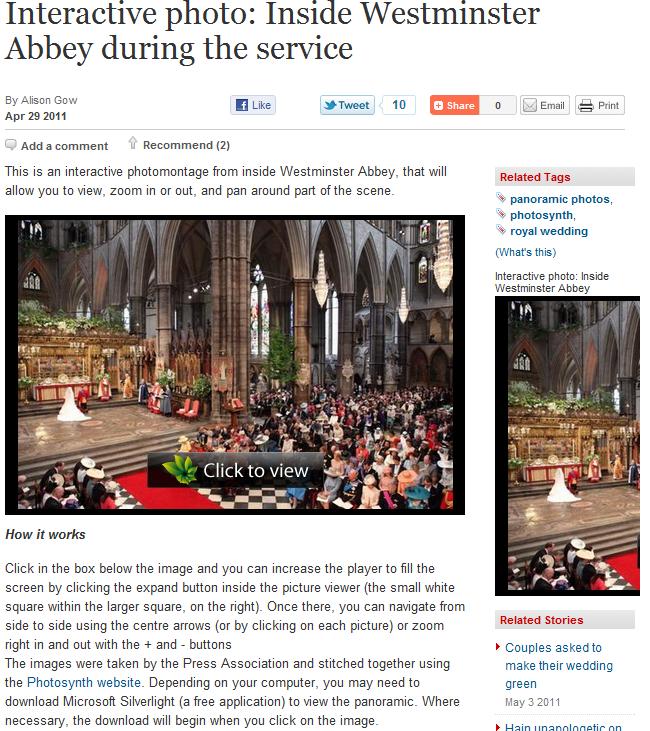
They are actually the same one. I’d made a Photosynth for the website on Friday – it took a quite bit of time to find photos that would allow a sort-of panoramic (only 87% in the end) embedded it and went on with the next task of the day.
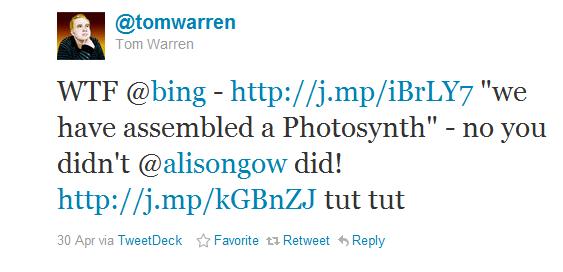
The next morning a tweet showed up in my stream
and then another one
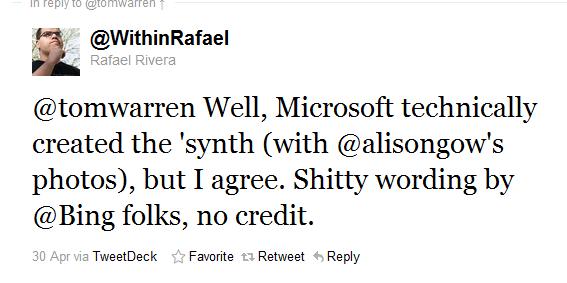
I’m not usually precious about this sort of thing; I enjoy using online tools like Photosynth and I support the idea of sharing content as widely as possible. Also, I could see Rafael’s point as Microsoft had allowed me to create that content in the first place.
The downside was that WalesOnline was missing out on a pretty decent traffic opportunity. And that a really simple bit of attribution had been skipped.
I’ve seen people nick other people’s tweeted jokes, and even pass off photos of their own on Flickr; this wasn’t in the same league but it still didn’t feel great. I worked hard on that thing, dammit!
But it didn’t end there, as it turned out. Tom took it up with Bing pr and look – a change of heart, thanks Bing.
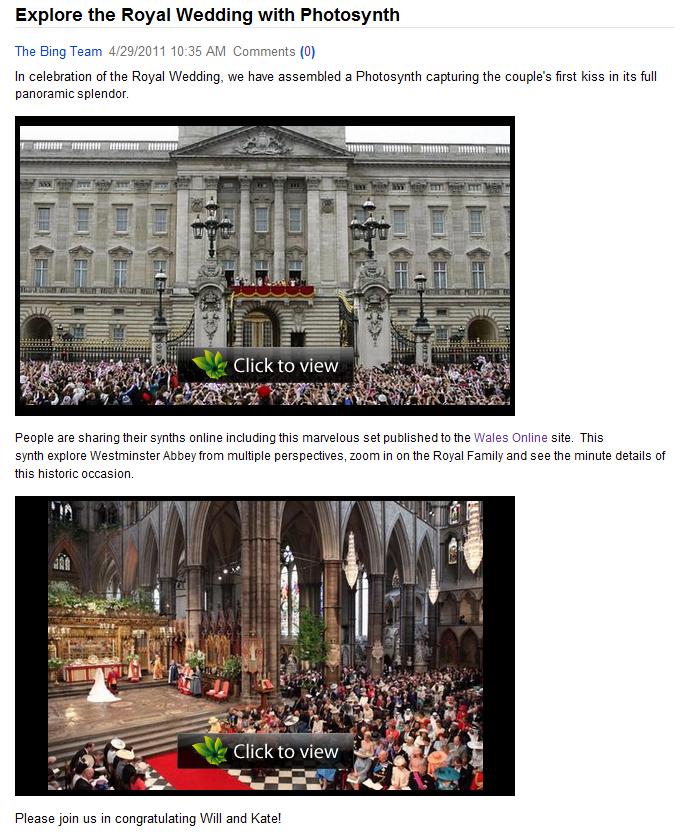
How cool is that? Almost as cool as this: someone I didn’t know took up cudgels on my behalf to see attribution was properly made. I thought that was really decent; how often have complete strangers stood up for your rights in real life? Nope, never happens. Except, sometimes it does.

 Alison Gow | Building the New
Leave a comment